Tag: DigitalExperience

  • DOME Launches in South America with N&E Support

    DOME Launches in South America with N&E Support

    DOME Goes International: Launching in Peru with N&E Support

    We’re excited to share that our very first international DOME implementation is now live in South America, right in the heart of Lima, Peru.

    The launch comes in partnership with N&E Support, a popular IT services company led by CEO Alfonso Bejarano, who has spent the past eight years delivering top-tier managed IT services, infrastructure oversight, and both preventive and corrective maintenance.

    From the start, this collaboration felt more like a creative partnership than a technical deployment. Alfonso and his team brought deep operational insight, and we brought a new way to surface that value to customers through the dynamic capabilities of DOME.

    The new site is built in Spanish, reflecting the needs of local users, but thanks to DOME’s multilingual interface, visitors can engage with content, ask questions, and receive intelligent, real-time responses in multiple languages automatically. No separate pages. No translation plug-ins. Just smart, on-demand personalization.

    Each of these interactions dynamically generates a personalized page based on user intent including rich media like images, videos, and more, styled and delivered as a fully responsive browser-native experience. And with DOME’s built-in journey bar, every request is saved as a shareable, printable, and exportable page, making the entire session both useful and memorable.

    Visit N&E Support website here: Tap or click here

    We’re proud to partner with Alfonso and the N&E Support team, and we’re even more excited about what this represents:

    A growing community of businesses embracing a better way to deliver information. We’re proud to be at the forefront, helping businesses move from clicks and tabs to conversation and context

    For our readers in Peru and South America:

    Este lanzamiento es especialmente significativo para nosotros, ya que Perú no solo marca nuestra primera implementación internacional de DOME, sino que también es el hogar de nuestros equipos de producción y desarrollo. Nos enorgullece ver cómo la innovación que nace dentro de SparxWorks en Perú ahora impulsa experiencias digitales inteligentes a nivel global.

  • From Clicks to Conversations: How AI Browsers, Agents, and MCP Rewrite Digital Strategy

    From Clicks to Conversations: How AI Browsers, Agents, and MCP Rewrite Digital Strategy

    You know this dance.

    You open a bank “Help” page to find the wire fee and get a maze of menu labels only a banker could love. The FAQ promises “quick answers,” then sends you through three pages of policy links, none of which match your account. You try chat. It asks for a detail you don’t have (“the exact plan code on your statement”), misreads your question, and loops you back to the same FAQ.

    Next day, your insurance portal won’t accept your claim number unless you format it with dashes you’ve never seen before. Your car dealer’s “Book Service” form can’t parse “check‑engine light came on after rain,” so you choose the closest option (“Other”) and pray someone calls. Utilities hide the phone number. “Contact us” means “convince our bot you exist.” If you finally reach a human, they’re reading a script that can’t handle anything off‑playbook.

    We’ve all been there, and our customers live there.

    That’s why the web is shifting from pages and menus to answers and actions. AI browsers let people ask once and get what matters, no detours. AI agents handle the task behind the scenes. Model Context Protocol (MCP), think “USB‑C for AI context, connects assistants to your systems safely. And with commerce now happening inside chat, even checkout is becoming conversational.

    This isn’t about tossing your website. It’s about adding an AI experience layer, your best sales rep, your most patient support pro, your clearest product expert, available on every page, in every channel, 24/7. At SparxWorks we call this DOME (Dynamic Omni Media Experience): capture user intent, assemble exactly the right content, and respond in seconds with privacy, accuracy, and your brand voice intact. Do that, and the path from question to conversion gets a whole lot shorter.

    Why revisit your website now?

    Because the surface area of the web has shifted. People are moving from hunting through menus to asking for exactly what they need, and getting it inside AI browsers, chat, and agents. Microsoft’s Copilot Mode in Edge is a live example: an “AI browser” experience that understands context and automates tasks beyond traditional page-by-page browsing. Windows Blog

    Brave’s Leo brings private, in‑browser summarization and content generation again, answers over navigation. Brave

    And the Arc ecosystem keeps pushing “Browse for Me,” summarizing top sources into an instant, human‑readable brief. arc.net

    AI is also becoming a channel, not just a tool

    In September, Shopify and OpenAI announced direct commerce inside ChatGPT, no link-out required. That means your product data, policies, inventory, and brand story can transact in a purely conversational interface. It’s not future tense; it’s shipping. Shopify

    Agents + MCP (Model Context Protocol) = the new integration fabric

    Static FAQs and locked-down “Contact Us” paths were built for a web of pages and phone trees. The next phase is AI agents that can reason, call tools, and hand off to each other; OpenAI’s Agents SDK and Responses API formalize that pattern for production. OpenAI Platform+1

    To wire those agents to your systems safely and consistently, MCP (Model Context Protocol) provides an open standard for connecting assistants to your data, tools, and dev environments, think “USB‑C for AI context.” Anthropic’s MCP is open-source and broadly documented, with official specs and GitHub resources available today. Anthropic+2Model Context Protocol+2

    What this means if you own product, marketing, or the P&L

    1) Your website becomes an answers API. Most sites trap knowledge in pages. AI surfaces want structured content and verifiable context. Refactor your content into modular blocks with clear taxonomies (products, eligibility, steps, policies, pricing), then expose it via retrieval and structured endpoints that agents, and AI browsers can use.

    2) Treat AI browsers as first-class distribution. If your information is buried behind menus, AI browsers will summarize others’ pages before they route to you. Publish machine-addressable content (FAQ schemas, product metadata, support intents) and track “answer coverage” (what percent of top intents return correct, complete answers). Edge Copilot Mode, Brave Leo, and Arc Max are showing users the value of “no-click” answers today. Windows Blog+2Brave+2

    3) Add agents with guardrails. Start with scoped agents (e.g., Support Triage, Product Finder, Post‑Purchase “Where is my order?”) using OpenAI’s agents stack, then plan for agent‑to‑agent (A2A) handoffs across marketing, commerce, and support. Build observability from day one so you can replay sessions, test prompts/tools, and continuously evaluate output quality. OpenAI Platform+1

    4) Use MCP to connect safely to your stack. MCP lets assistants access the right tools/data with consistent permissions. It’s an open protocol with multi-language SDKs and an evolving ecosystem—meaning faster integrations, less custom glue code, and clearer access controls. Model Context Protocol+1

    5) Design for privacy, provenance, and control. Prefer first‑party content, strong retrieval, and human‑visible citations where appropriate. Log what was shown and why. Keep customer data private by default; choose models and tools that can run with least‑privilege access and clear auditability. (Reminder: Brave publicly positions Leo around privacy as a differentiator—users notice.) Brave

    What “good” looks like in 2026

    • <3s time‑to‑answer for the top 50 customer intents.
    • >90% answer coverage (the system can find and assemble an answer from your content).
    • Resolution without handoff for routine tickets (returns, status, eligibility) via agents, with clear audit logs. OpenAI Platform
    • Consistent brand voice and policy adherence across site, chat, and AI browsers (same content, one source of truth).

    A word of caution

    Anybody can bolt on a chatbot. Making it right, accurate, on‑brand, and private, takes experience across backend integration, UX, and content design. Picking a partner that knows how to modularize content, wire agents safely (via MCP), and maintain governance will determine whether your AI boosts trust, or breaks it.

    If you want to explore a dynamic integration, chatbot, agentic workflows, or a full dynamic experience layer (our DOME approach), DM me or contact SparxWorks. We’ll help if we’re a fit; and if not, we’ll point you to the right partner.

  • From Funnels to Conversations: The Shift Every Brand Must Make

    From Funnels to Conversations: The Shift Every Brand Must Make

    [videojs_video url=”https://vod.sparxworks.com/abc56b4c-e7a6-4e40-9f9b-ba50b4cdba0e/AppleHLS1/DOME_shopping_20250923.m3u8″ poster=”https://devdomewp.justdomeit.com/wp-content/uploads/2025/09/thumbnail.webp”]

    The Interface is Dead. Long Live the User.

    Your website is no longer just a digital brochure; it’s your first impression, your frontline sales rep, your customer onboarding tool, and often your only shot at a meaningful connection.

    However, most websites still treat users like passive readers instead of what they actually are: active, impatient decision-makers.

    Millennials and Gen Z expect to participate. They don’t want to scroll through pages of irrelevant content. They want to ask one question and get the perfect answer. They want the experience to adapt to them, not the other way around.

    That’s where DOME (Dynamic Omni Media Experience) comes in.

    DOME flips the outdated model of web navigation on its head. It lets users drive their own experience using natural questions, preferences, and behaviors. With voice or text, they describe what they need, and DOME responds with intelligent, real-time results: recommendations, comparisons, bundles, and next steps.

    Personalization isn’t just about improving conversion rates; it’s the foundation of brand relevance.

    When users feel understood, they don’t just buy, they remember. They trust. They come back. That moment when a customer thinks, “this brand gets me”? That’s where loyalty begins. And in a marketplace drowning in options, relevance is everything.

    Younger audiences especially view personalization as a baseline expectation. It’s their signal that your brand is modern, empathetic, and worth engaging with. When your digital experience adapts to them, they feel seen, not sold to.

    Brands that get this right don’t just make a sale, they make a connection. And in a world of fleeting attention, connection is currency.

    This is more than convenience. It’s survival.

    If your digital presence doesn’t feel personalized, intuitive, and user-driven, today’s consumers won’t wait around. They’ll leave. And they won’t come back.

    Personalization is now the expectation, not the extra. Brands that deliver it, the right way position themselves as modern, responsive, and customer-centric. Brands that don’t? They fall behind.

    DOME makes personalization effortless, scalable, and aligned with how people actually think.

    It’s not about patching your old system. It’s about evolving with your audience, and ideally staying one step ahead. Because the future isn’t about forcing people to adapt to interfaces.

    It’s about building experiences that adapt to people.

    Want to be seen as innovative, responsive, and human? It starts with how you deliver digital experiences. And personalization is your first language. Visit us at SparxWorks.com to learn more about DOME, or DM me.

  • When the Interface Disappears: The Rise of Conversational Experiences

    When the Interface Disappears: The Rise of Conversational Experiences

    The New Gateway: How Conversational AI Is Redefining Virtual Engagement

    For decades, digital interfaces have been static and reactive, with clicks to navigate, scrolls to explore, and searches to find. But we are now standing at the threshold of a profound shift: a transition from structured content browsing to dynamic, intent-driven interaction.

    Conversational AI is not just a tool; it’s the interface of a new digital era.

    Modern users no longer want to “browse” for answers. They want to speak or type a question and receive a direct, multimodal response, text, video, audio, interactive content, all delivered in real time, shaped by context, and adapted to device. This shift transforms not only how content is accessed, but how it’s structured, delivered, and remembered.

    From Interface to Intelligence

    At the center of this transformation is the concept of the digital “gateway”: not a website or app, but a responsive layer that interprets user intent and curates experiences accordingly. Whether it’s a student asking for a lesson summary, a shopper requesting a product in blue, or a traveler asking for real-time itinerary updates, AI is the new concierge, and language is the new navigation.

    This gateway does more than translate queries into search results. It intelligently assembles content, modular, tagged, and media-rich, and delivers it as cohesive, conversational responses. Think of it as a personalized microsite generated on demand, tailored for the individual moment.

    Multimodal by Design

    Voice, video, text, and interactivity are no longer separate channels. The future of engagement is unified. A single prompt can yield a narrated explainer, an interactive diagram, and a link to take action, all orchestrated by an AI that understands not just the request, but the requester.

    This convergence also breaks down barriers between platforms. The same intelligent experience can live on mobile, desktop, smart TVs, kiosks, and even immersive AR/VR spaces, without rebuilding content for each format.

    Virtual Presence, Real-Time Connection

    In enterprise, education, retail, and beyond, the implications are huge. Customer service shifts from reactive to predictive. Learning becomes personalized and on-demand. Commerce evolves from catalog to conversation.

    And all of it is powered by a backend that learns, adapts, and improves, an engagement system that never stops optimizing.

    The age of clicking through is ending. The age of conversing through has begun.

    Virtual engagement is no longer about drawing people into a website; it’s about bringing the right content, in the right form, to them. Directly. Dynamically. Intelligently.

    If you want to learn more about this topic, visit our website at www.sparxworks.com or contact me.

  • Future-Proof Your Website: What Is GEO and Why It Matters

    Future-Proof Your Website: What Is GEO and Why It Matters

    For 35 years, websites have been built for human navigation: menus, tabs, categories, clicks. SEO, search engine optimization, was the system we used to get those human visitors in the door.

    But AI browsers like Comet and Operator are changing the rules. Instead of sending a user to a list of links, these browsers act as agents:

    • Comet lets you highlight text or ask a question in its sidebar, then delivers summaries, answers, and citations instantly, without leaving the page.
    • Operator (expected from OpenAI) will go further, executing multi-step tasks, comparing products, and proactively offering insights during your browsing session.

    In this environment, SEO’s “rank for keywords” approach matters far less. What matters is whether AI systems can understand, trust, and use your content in the exact moment a user needs it.

    That’s where GEO, Generative Experience Optimization, comes in.

    What is GEO?

    Generative Experience Optimization (GEO) is the evolution of SEO for the AI-first internet. Instead of optimizing for search engines that display a list of links, GEO optimizes for AI systems, like Comet, Operator, and other agentic browsers that read, summarize, synthesize, and act on your content in real time.

    With GEO, the goal isn’t just to be found, it’s to be understood, trusted, and directly used by AI models during a conversation or task execution. GEO shifts the focus from visibility to usability in the AI era:

    1. Clear Topic, Intent, Content Alignment – Content is structured not just by subject, but by the intent behind user queries. This ensures AI understands the “why” of a question, not just the “what,” allowing it to deliver more relevant answers.
    2. Semantic Match over Keyword Density – Instead of relying on exact keyword repetition, GEO makes content machine-readable through metadata, context-rich descriptions, and vectorization. AI retrieves based on meaning, so even varied phrasings or synonyms still connect to your content.
    3. Contextual Answer Extraction – Content is modularized into discrete, self-contained blocks so AI can pull precise, citation-ready answers, whether text, video, images, audio, or interactive elements, directly into the user’s flow without extra clicks.

    Why DOME Is GEO Ready

    Most websites scatter information across multiple pages. AI browsers must piece it together, often missing context or depth.

    A DOME-powered website, however, is different because DOME is AI-native. From its foundation, DOME was designed to work the way AI systems think and process information, not the way humans click through menus. It is optimized for GEO from the start, meaning every technical and structural decision supports AI-first comprehension and delivery.

    With DOME, you get:

    • Modular Content Structure – Every piece of content is broken into indexed, vectorized modules.
    • AI-Optimized Metadata – Each module is tagged by topic, sub-topic, and intent, making it easy for AI to match queries.
    • Omni-Format Output – DOME can serve text, video, audio, 3D, or interactive diagrams, whichever format answers the query best.
    • No Navigation Barriers – Users (or AI agents) don’t have to click through menus; DOME delivers exactly what’s asked for, instantly.
    • AI-Agent Ready – DOME’s modular, metadata-rich architecture allows AI agents like those in Comet and Operator to instantly retrieve, understand, and act on your content, making it a natural partner for task-executing, conversational browsing.

    Because DOME is built from the ground up for AI compatibility, it doesn’t have to “retrofit” for GEO; it’s already fluent in it.

    The Advantage

    When Comet or Operator encounters a DOME-powered site, it’s not crawling a series of static pages; it’s accessing a real-time, AI-readable knowledge base. That means:

    • Faster, more accurate answers for the user.
    • Higher likelihood that your content is cited (and linked) in AI responses.
    • Better engagement, even if users never “visit” in the traditional sense.

    In the AI browser era, visibility comes from comprehension, not clicks.

    SEO got you on page one. GEO makes you the answer.

    DM me or visit our website www.SparxWorks.com for more information.

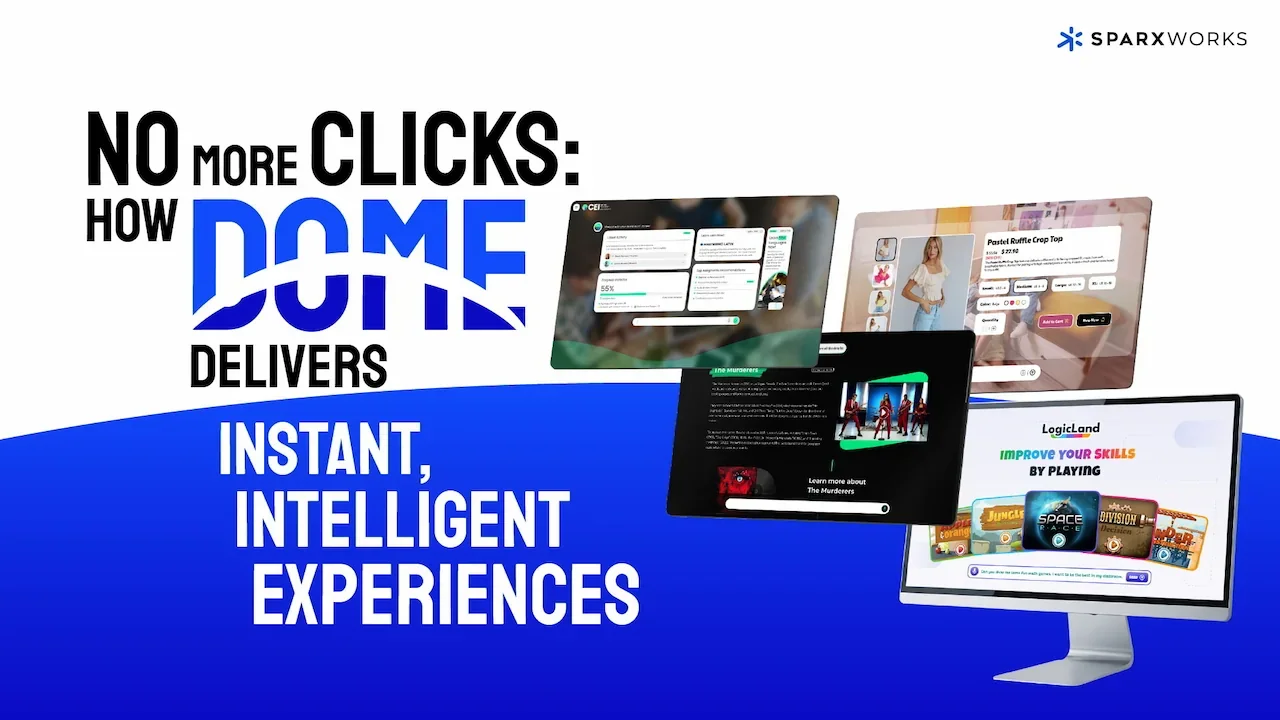
  • No More Clicks: How DOME Delivers Instant, Intelligent Experiences

    No More Clicks: How DOME Delivers Instant, Intelligent Experiences

    The web is 35 years old. And it shows.

    Despite decades of redesigns, the fundamentals haven’t changed: menus, tabs, and the eternal hunt for the right link. The result? Most users bounce in under a minute, frustrated and unfulfilled. IBM estimates this digital confusion costs businesses $62 billion annually.

    But the real problem isn’t the design. It’s the paradigm.

    As noted in “Beyond the Click,” redesigns still ask users to do all the work: click here, scroll there, dig through dropdowns. Today’s users don’t browse, they ask. From Siri to ChatGPT, the bar has shifted. People expect systems to understand intent, respond in seconds, and deliver content dynamically.

    That’s exactly what DOME was built to do.

    Meet DOME, the Dynamic Omni Media Experience. It’s an AI-powered system that ditches static web design in favor of real-time interaction. No menus. No categories. Just results.

    With DOME, users speak or type their needs, and the system instantly assembles a personalized experience. Text, video, 3D content, PDFs, even support forms all modularized, categorized, and delivered in response to a natural-language request.

    And it’s not just for tech giants. DOME was designed specifically to help SMBs compete in a landscape dominated by speed, personalization, and omnichannel access. Whether you’re in education, healthcare, e-commerce, or support services, DOME helps you:

    • Turn static content into intelligent answers
    • Reduce bounce rates and user friction
    • Deliver personalized paths on any device (mobile, desktop, TV, even voice)
    • Plug into your existing CRM, CMS, LMS, or eCommerce stack—no need to rebuild

    Instead of forcing users to learn your site, DOME learns from your users. It continuously improves delivery based on behavior and queries, giving you smarter insights and better outcomes.

    Imagine a customer support page that answers questions like a concierge. Or a course portal that surfaces relevant lessons based on a student’s last interaction. That’s not a redesign—that’s a reinvention.

    We call it orchestration over navigation.

    For SMBs tired of expensive overhauls and underwhelming results, DOME offers a breakthrough: a scalable, defensible platform that amplifies what you already have. And delivers what your users have been waiting for.

    If your users are clicking and bouncing, it’s time for something better. DOME transforms digital frustration into intelligent connection. Let’s build the new standard together.

    Learn more at sparxworks.com

    DM me to explore DOME for your business.

  • Beyond the Click: The Quiet Revolution in Digital Experiences

    Beyond the Click: The Quiet Revolution in Digital Experiences

    In the age of instant gratification, the way we design and interact with websites is reaching a tipping point. With average user engagement lasting under a minute and bounce rates exceeding 70% on many sites, it’s clear that traditional website structures no longer serve modern expectations.

    The current model, based on categories, menus, and static pathways, requires users to work for information. And they’re no longer willing to do that. Whether it’s a student searching for a course, a patient trying to book an appointment, or a shopper comparing products, the expectation is the same: “Give me what I want, right now.”

    The Illusion of Redesign

    Most website overhauls focus on aesthetics or reorganization, but the architecture stays the same. The assumption is that better design equals better performance. But what if the problem isn’t the design but the paradigm itself?

    Redesigning for the same behaviors, clicking, searching, and backtracking, keeps users trapped in outdated patterns. The result? Lost engagement, frustrated customers, and missed opportunities for real-time connection.

    What Users Want (But Aren’t Getting)

    Today’s digital consumers are shaped by intelligent systems. AI-powered tools like Siri, ChatGPT, and personalized shopping experiences have set a new bar. Users now expect systems to understand intent, not just respond to inputs. They want:

    • Relevant answers in 5 seconds or less
    • Media-rich content delivered instantly
    • Personalized paths, not generic funnels
    • Omnichannel access: mobile, desktop, voice, TV

    The Shift from Browsing to Asking

    The next generation of digital platforms won’t be about better clicks—they’ll be about eliminating clicks altogether. Websites and apps will become responsive systems that generate experiences on the fly, based on natural language input. Instead of navigating to a resource, users will summon it.

    Think of it not as navigation, but as orchestration.

    Designing for Zero Friction

    To meet these demands, content must be:

    • Modularized and tagged intelligently
    • Delivered in response to voice or text prompts
    • Compatible across any device or format
    • Connected with existing CRMs, CMSs, and LMSs
    • Updatable in real-time without manual intervention

    This isn’t just a design challenge; it’s an operational transformation. But for those who make the leap, the reward is immense: lower bounce rates, higher engagement, and a digital experience that actually feels intelligent