Tag: Ecommerce

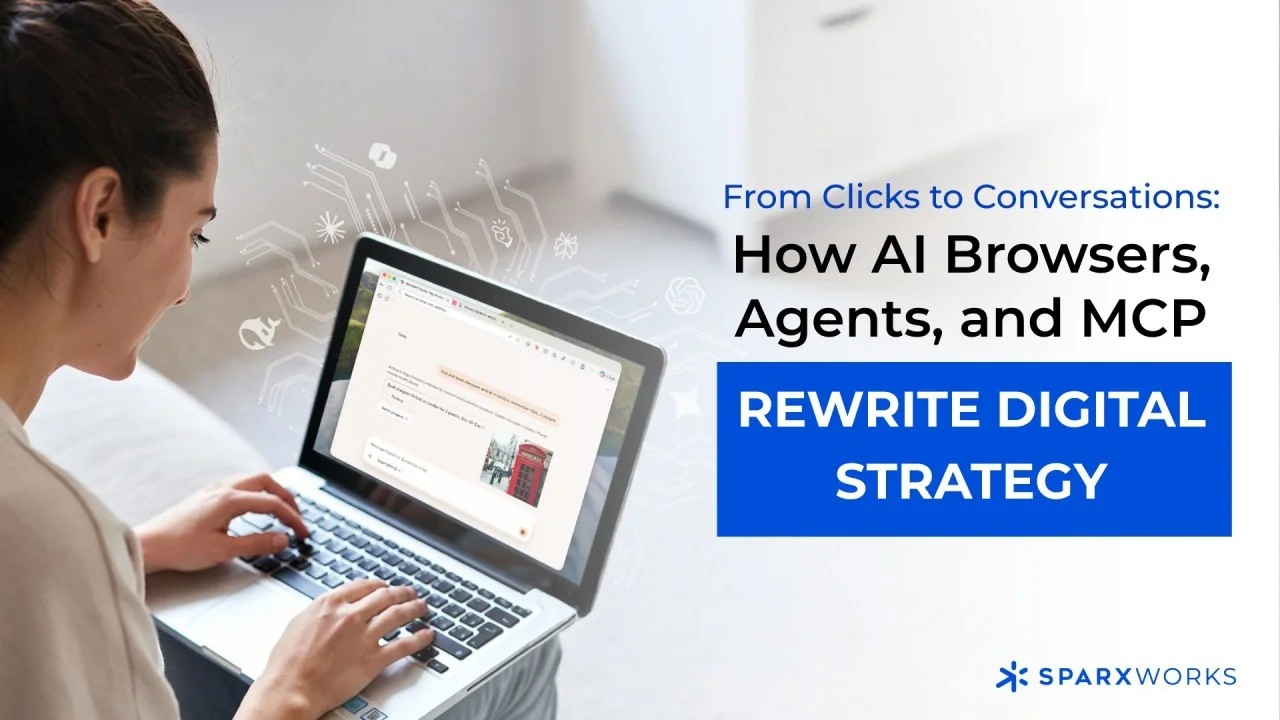
  • From Clicks to Conversations: How AI Browsers, Agents, and MCP Rewrite Digital Strategy

    From Clicks to Conversations: How AI Browsers, Agents, and MCP Rewrite Digital Strategy

    You know this dance.

    You open a bank “Help” page to find the wire fee and get a maze of menu labels only a banker could love. The FAQ promises “quick answers,” then sends you through three pages of policy links, none of which match your account. You try chat. It asks for a detail you don’t have (“the exact plan code on your statement”), misreads your question, and loops you back to the same FAQ.

    Next day, your insurance portal won’t accept your claim number unless you format it with dashes you’ve never seen before. Your car dealer’s “Book Service” form can’t parse “check‑engine light came on after rain,” so you choose the closest option (“Other”) and pray someone calls. Utilities hide the phone number. “Contact us” means “convince our bot you exist.” If you finally reach a human, they’re reading a script that can’t handle anything off‑playbook.

    We’ve all been there, and our customers live there.

    That’s why the web is shifting from pages and menus to answers and actions. AI browsers let people ask once and get what matters, no detours. AI agents handle the task behind the scenes. Model Context Protocol (MCP), think “USB‑C for AI context, connects assistants to your systems safely. And with commerce now happening inside chat, even checkout is becoming conversational.

    This isn’t about tossing your website. It’s about adding an AI experience layer, your best sales rep, your most patient support pro, your clearest product expert, available on every page, in every channel, 24/7. At SparxWorks we call this DOME (Dynamic Omni Media Experience): capture user intent, assemble exactly the right content, and respond in seconds with privacy, accuracy, and your brand voice intact. Do that, and the path from question to conversion gets a whole lot shorter.

    Why revisit your website now?

    Because the surface area of the web has shifted. People are moving from hunting through menus to asking for exactly what they need, and getting it inside AI browsers, chat, and agents. Microsoft’s Copilot Mode in Edge is a live example: an “AI browser” experience that understands context and automates tasks beyond traditional page-by-page browsing. Windows Blog

    Brave’s Leo brings private, in‑browser summarization and content generation again, answers over navigation. Brave

    And the Arc ecosystem keeps pushing “Browse for Me,” summarizing top sources into an instant, human‑readable brief. arc.net

    AI is also becoming a channel, not just a tool

    In September, Shopify and OpenAI announced direct commerce inside ChatGPT, no link-out required. That means your product data, policies, inventory, and brand story can transact in a purely conversational interface. It’s not future tense; it’s shipping. Shopify

    Agents + MCP (Model Context Protocol) = the new integration fabric

    Static FAQs and locked-down “Contact Us” paths were built for a web of pages and phone trees. The next phase is AI agents that can reason, call tools, and hand off to each other; OpenAI’s Agents SDK and Responses API formalize that pattern for production. OpenAI Platform+1

    To wire those agents to your systems safely and consistently, MCP (Model Context Protocol) provides an open standard for connecting assistants to your data, tools, and dev environments, think “USB‑C for AI context.” Anthropic’s MCP is open-source and broadly documented, with official specs and GitHub resources available today. Anthropic+2Model Context Protocol+2

    What this means if you own product, marketing, or the P&L

    1) Your website becomes an answers API. Most sites trap knowledge in pages. AI surfaces want structured content and verifiable context. Refactor your content into modular blocks with clear taxonomies (products, eligibility, steps, policies, pricing), then expose it via retrieval and structured endpoints that agents, and AI browsers can use.

    2) Treat AI browsers as first-class distribution. If your information is buried behind menus, AI browsers will summarize others’ pages before they route to you. Publish machine-addressable content (FAQ schemas, product metadata, support intents) and track “answer coverage” (what percent of top intents return correct, complete answers). Edge Copilot Mode, Brave Leo, and Arc Max are showing users the value of “no-click” answers today. Windows Blog+2Brave+2

    3) Add agents with guardrails. Start with scoped agents (e.g., Support Triage, Product Finder, Post‑Purchase “Where is my order?”) using OpenAI’s agents stack, then plan for agent‑to‑agent (A2A) handoffs across marketing, commerce, and support. Build observability from day one so you can replay sessions, test prompts/tools, and continuously evaluate output quality. OpenAI Platform+1

    4) Use MCP to connect safely to your stack. MCP lets assistants access the right tools/data with consistent permissions. It’s an open protocol with multi-language SDKs and an evolving ecosystem—meaning faster integrations, less custom glue code, and clearer access controls. Model Context Protocol+1

    5) Design for privacy, provenance, and control. Prefer first‑party content, strong retrieval, and human‑visible citations where appropriate. Log what was shown and why. Keep customer data private by default; choose models and tools that can run with least‑privilege access and clear auditability. (Reminder: Brave publicly positions Leo around privacy as a differentiator—users notice.) Brave

    What “good” looks like in 2026

    • <3s time‑to‑answer for the top 50 customer intents.
    • >90% answer coverage (the system can find and assemble an answer from your content).
    • Resolution without handoff for routine tickets (returns, status, eligibility) via agents, with clear audit logs. OpenAI Platform
    • Consistent brand voice and policy adherence across site, chat, and AI browsers (same content, one source of truth).

    A word of caution

    Anybody can bolt on a chatbot. Making it right, accurate, on‑brand, and private, takes experience across backend integration, UX, and content design. Picking a partner that knows how to modularize content, wire agents safely (via MCP), and maintain governance will determine whether your AI boosts trust, or breaks it.

    If you want to explore a dynamic integration, chatbot, agentic workflows, or a full dynamic experience layer (our DOME approach), DM me or contact SparxWorks. We’ll help if we’re a fit; and if not, we’ll point you to the right partner.
  • From Clicks to Customers: The Solution to a $2 Trillion Problem

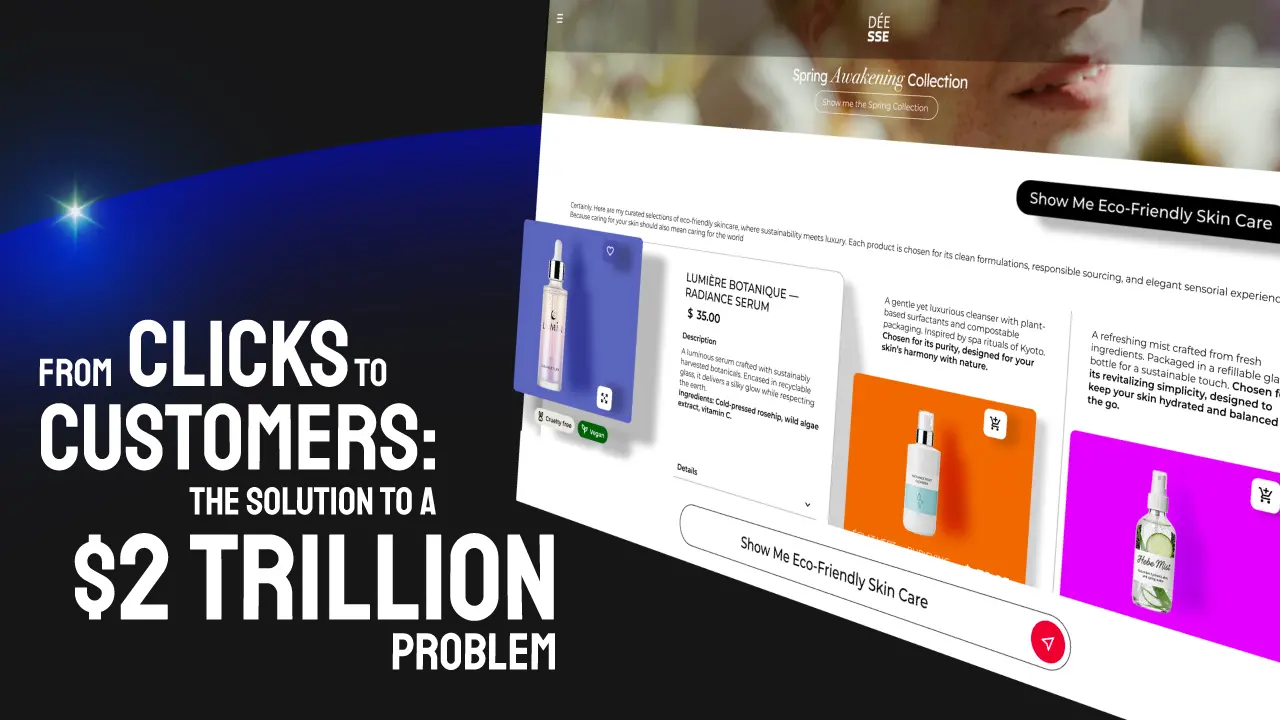
    From Clicks to Customers: The Solution to a $2 Trillion Problem

    [videojs_video url=”https://vod.sparxworks.com/792ac87d-f716-471f-8ab9-8944ff243d3e/AppleHLS1/animation-dome.m3u8″ poster=”https://devdomewp.justdomeit.com/wp-content/uploads/2025/09/thumbnail_1280x720.webp”]

    You built your business to help people.

    Maybe you’re selling handcrafted tea blends, managing an online course, or building a service that solves a problem you care deeply about.

    You set up your site. You tweaked every headline, optimized your product pages, maybe even ran some ads. But then, crickets.

    People show up… and leave. They don’t convert. They don’t stay long enough to understand what makes your offer different. You can feel the gap, even if you can’t name it.

    It’s not your product. It’s not your passion.

    It’s the interface.

    The Web’s Old Operating System

    Most of today’s websites still run on a 1980s concept called WIMP: Windows, Icons, Menus, Pointer. It was fine when desktops ruled, and we all navigated with clicks. But today, users don’t point; they talk, tap, and expect instant results.

    They’re not browsing for answers. They’re asking for them.

    And yet, we’re still giving them dropdowns. Still burying the return policy four clicks deep. Still asking them to figure out our system before they can get what they want.

    That friction? It’s costly.

    According to Google, bad online experiences cost businesses over $2 trillion globally annually. And most small and medium businesses feel that in miss opportunities and waste ad spend.

    Rethinking the Interface: From WIMP to Conversation

    That’s why we built DOME, the Dynamic Omni Media Experience.

    DOME isn’t a redesign. It’s a rethink.

    It wraps around your existing content, your product listings, FAQs, tutorials, documents, and transforms them into real-time, modular responses that adapt to every user.

    Your customers don’t want to scroll. They want to ask:

    • “Do you ship internationally?”
    • “Can I see this in another color?”
    • “What’s the difference between the plans?”

    And DOME responds, instantly, naturally.

    In 59 languages. As text, video, interactive cards, and even 3D. Across mobile, desktop, smart displays, and more.

    It feels less like browsing a website and more like having a conversation with someone who gets you.

    Why This Matters Now

    It’s not just about speed, it’s about relevance.

    DOME personalizes every interaction based on user behavior, intent, and even location. It remembers previous sessions. It adapts content format to fit the device and moment.

    This isn’t personalization as a marketing buzzword. This is content that speaks your customer’s language, literally and figuratively.

    And it works.

    • Bounce rates drop as users quickly find what they need.
    • Support inquiries shrink as self-service becomes intuitive.
    • Conversions rise, especially among mobile-first shoppers who no longer have to dig for answers.

    One customer is piloting DOME as a replacement for their traditional search bar, creating a faster, more conversational way for shoppers to discover what they’re looking for.

    The Takeaway

    You don’t need to rip and replace your website.

    You don’t need a $100K redesign.

    What you need is a digital layer that listens first and responds like a human.

    That’s what DOME does.

    It makes your site conversational, contextual, and ready for the way your customers already think.

    Because the future of digital isn’t more clicks. It has fewer barriers.

    Explore how DOME can work for your business at SparxWorks.com. Or just ask like your customers would.

  • 10 Ways AI Can Revive Retail Sales in 2025

    10 Ways AI Can Revive Retail Sales in 2025

    Retail just took a big hit to start the year—sales dropped 0.9% in January, way worse than the 0.2% decline economists expected. Blame it on the usual post-holiday slump, inflation worries, or that brutal winter freeze—it’s a tough start for retailers. If this trend keeps up, we could be looking at an even slower Q1 for the economy. But here’s the thing: AI isn’t just a buzzword anymore—it’s a game-changer. The right AI-driven strategies can help retailers bounce back by optimizing operations, personalizing shopping experiences, and boosting sales. Let’s dive into 10 AI-powered solutions that can help retailers turn things around fast.

    1. Personalized Customer Experiences

    AI analyzes purchase history, preferences, and real-time behavior to offer tailored recommendations. Retailers using AI-driven personalization have seen 10-30% increases in revenue.

    2. AI-Powered Dynamic Pricing

    Smart pricing algorithms adjust product prices based on demand, competitor activity, and even weather patterns. This helps retailers remain competitive while protecting profit margins.

    3. Predictive Inventory Management

    By analyzing historical sales data and market trends, AI can forecast demand more accurately, reducing overstock and out-of-stock issues.

    4. AI Chatbots for 24/7 Customer Engagement

    Retailers using AI chatbots can handle up to 80% of customer inquiries without human intervention, improving response time and customer satisfaction.

    5. Enhanced Visual Search & Virtual Try-Ons

    AI-powered image recognition allows shoppers to search for products by uploading photos. Virtual try-on technology (for apparel, accessories, and cosmetics) boosts conversion rates by 2-3x.

    6. AI-Optimized Supply Chains

    By identifying potential disruptions and alternative solutions, AI-driven logistics improve delivery efficiency and reduce costs.

    7. Fraud Prevention & Secure Transactions

    AI detects anomalies in purchasing behavior, preventing fraud in real time, securing transactions, and increasing consumer trust.

    8. Sentiment Analysis for Market Trends

    AI scans social media, reviews, and feedback to detect emerging trends and customer sentiment, helping retailers make smarter product decisions.

    9. Smart Store Layout Optimization

    AI-driven insights on foot traffic patterns can help retailers adjust store layouts, improving product placement and boosting sales.

    10. AI-Powered Ad Targeting

    AI refines ad strategies by identifying high-intent shoppers and delivering hyper-personalized ads, increasing ROI on digital marketing efforts.

    The Key to Retailers facing declining sales must embrace AI as a strategic partner in their revival. From optimizing supply chains to creating more personalized customer experiences, AI can reignite retail sales growth in 2025 and beyond.