Tag: VIDEO

  • What Will Happen with Print Media in the Age of the Metaverse?

    What Will Happen with Print Media in the Age of the Metaverse?

    “Print media is dead. No one wants to read anymore.”   These are things we often hear on the news.  These opinions, or trends, are heavily influenced by current video consumption habits and consumers’ well-documented resistance to reading long pieces. But these statements are just not true. Indeed no one wants to read a manual. However, we all like to read a good novel, a book about something we are interested in, or perhaps an excellent social post. Books are not going away; they are just transforming.

    Augmented reality (AR) will become an essential transformation tool for print media. Through AR, already existing books, newspapers, signs, etc., can all be enhanced, bringing new life and renewed interest from consumers.

    Imagery from printed materials can be made interactive through Image recognition. With this technology, any image in a book could become alive.  You might see a photo of George Washington in a book, and he will start talking to you, or perhaps another image will trigger an interactive map of a famous battle. Billboards, signs, and logos will all also become interactive. All the analytics we get from using the web and mobile apps can now also be obtained from print media and objects, thanks to AR.

    AR will elevate the level of engagement and connection between the product or brand and the end user. Books, articles, and other printed materials will no longer be your “Father’s” read but rather a new interactive and dynamic way to experience a story or learn about something.

    Schoolchildren Use Digital Tablet Computers and Smartphones with Augmented Reality Software

    Books and printed materials can have digital companion applications. These applications could make portions or contents in a book interactive, can trigger digital experiences, and can provide further support for the story or concept the reader is exploring. Imagine opening a history book and reading about the declaration of independence, and suddenly, you are there, fully immersed in 3D, witnessing the signing of our constitution! Volumetric, like the real thing!

    If you want to see a simple example, you can explore our ABC Animals Alphabet in Motion title. This is a simple ABC book that engages early readers with the help of mom and dad to develop an early love for reading the magical experiences reading can bring.  Each page has a special surprise; making the first time your child sees the alphabet truly memorable. You can find the book on Amazon Tap or click to view the book

    Digital companion art, interactive content, or 3D objects combined with an NFT can create additional value for products (the Metaverse will create many new distribution channels). Or additional sales (digital), collectibles, and more.

    We all love a good story and inspiring, unforgettable characters We also love to read about things that interest us in detail. Books will need to evolve, like all media. We at SparxWorks have been working with print media, education, training, and family entertainment for the past two decades, with almost ten years of experience with AR. We share the love of reading and learning and have created an amazing ecosystem to support print media’s transition into the Metaverse. If you want to learn more about available tools and options for print media, contact us by tapping or clicking here.
  • Is Augmented Reality the Actual Path to Virtual Reality?

    Is Augmented Reality the Actual Path to Virtual Reality?

    Is AR the road to real VR? If you have asked yourself the same question, please comment or share your thoughts with this post. I am working on two (very different) immersive projects and would love to hear what other people are working on, AR or VR, think about this. Hear me out and let me share briefly what I am doing and see what you think

    I am working on an AR project, a “life-size-location event,” a “Haunted House.” It is a real size environment; it will need to be experienced outdoors, on a field, gym, or some other area where you can fit a house J (baseball, football fields are great choices).


    As we’ve worked on the project, the journey has been incredible. I have often stopped and asked our team, “Wait, are we still doing augmented reality? Or are we now doing VR?” It was both a moment of reflection and realization. We can deliver a closer experience to the “Holodeck from Star Trek” in terms of the user experience with AR—you can walk, interact with objects, digital elements, and characters, etc.


    Don’t get me wrong. I love the Oculus VR products and their super talented developers; they make fantastic stuff, too. But in terms of the overall experience, I would suggest that AR is indeed the true path to VR. With 5G fast growth and multi-access edge computing, we’ll be able to deliver a unique realistic experience of the same quality as a PlayStation or Xbox. Furthermore, you will no longer be bound to a chair or small room, or computer for that matter.


    I, of course, started to think about the possibilities for education, retail, architecture, hospitality, wellness, and entertainment, to name a few natural fits for AR. For example, take a walk through the city of Troy, or observe the battle of Waterloo, Conduct a science experiment, and so much more. Combined with props, you can have a completely interactive experience that includes touch in addition to an audio-visual experience. We have been able to also experiment with a store, apartment, and even a stadium.


    Our second project I can tell you more about. It is a small micro-game. I am releasing it next week (it is free). This is a very light shooter game. As I played the game, I became as immersed in it as when I played simple games on a console-based or mobile device, except that I was an active participant this time. I also played with others (I was at a park), which made it fun and social, something I think we all need. Since we were outside, we were also safe.


    Please take a minute to share your experiences if you are working on similar initiatives; I’d love to hear from you.

    If you would like to know more about our augmented reality services, please contact us through our website www.sparxworks.com. Also, we are going to be demonstrating various immersion concepts this November 15 at www.ARExperience.us. This experiential conference will bring together the top brands and agencies with the hottest companies and services in AR in a collaborative way to foster the growth of our AR community.

    We look forward to seeing you there at the Faena Hotel in Miami beach.

  • Augmented Reality: how do I get started? Five easy steps.

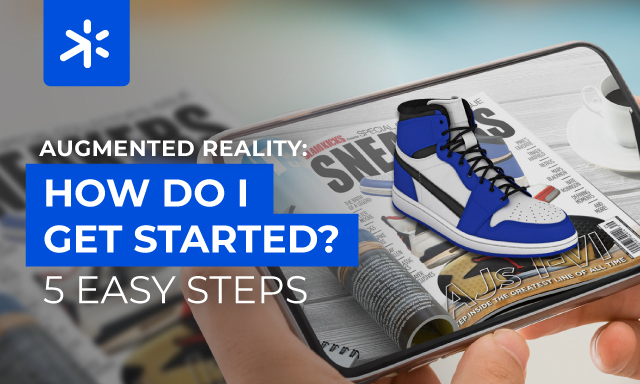
    Augmented Reality: how do I get started? Five easy steps.

    OK, I want to use AR. How do I get started? Five easy steps.


    Do you work in marketing? Or advertisement, branding or sales? Would you like to take advantage of the many benefits AR brings but are new to or inexperienced with immersive technologies? I think I can offer some help.

    Selecting the right cost-effective AR solution for your company can be a mind-boggling task. However, if you ask the right questions you’ll find that AR is surprisingly affordable.  A simple AR strategy may add less than $10K to your budget.


    1. Identify and set up your goal
      • What do you want to do with AR? Extend your brand? Provide support for your products and services?
      • What tools do you already have? Website? Mobile application(s)? How or where do you plan to add AR?
    2. Set up a budget
      • If you are exploring if AR is suitable for you, running a pilot project is a good idea. Decide on the sum you want to invest.
      • Set up a period of time for the pilot or initiative. This will help you measure success with analytics.
    3. Keep in mind the audience you are trying to reach
      • This is important in selecting a distribution channel (for example, if you are trying to reach users over 35, Snapchat would not be a good choice, on the other hand, if your audience is under 35 it is a great choice.)
    4. Understand the logistics and timing
      • Be clear on the kind of AR you are interested in implementing.
      • Understand the main differences between AR technologies.
      • Make sure you set up a realistic timeline.
    5. Use analytics, make sure you can measure results
      • Make sure you collect and analyze data.
      • What you learn will be directly linked to the goals you set up for the project.
      • Make sure the data sampling you are using covers enough ground to make an objective assessment.


    If you don’t have a team well versed in immersive technologies, the best approach is to start with a platform or tools of well-established AR platforms. While AR technologies and platforms are growing fast, here is a list of some of the top options you may want to consider


    If you want to learn more about our versatile AR platform, please contact me or visit our website www.sparxworks.com or see us on November 15 at www.ARExperience.us. This experiential conference will bring together the top brands and agencies with the hottest companies and services in AR in a collaborative way to foster the growth of our AR community. We look forward to seeing you there at the Faena Hotel in Miami beach.

  • AR publishing in 3 easy steps under 5 minutes!

    AR publishing in 3 easy steps under 5 minutes!

    As I’ve explained in the past, devising an AR strategy for your business is a complex process with many variables, but the good news is that with SparkWorks’ AR technology, publishing AR content is very simple!  What if you could spend your time designing, asking the right questions, leveraging AR across print media, objects, mobile applications, and your eCommerce/website without worrying about programming? At SparxWorks, we are 100% focused on making the process of publishing AR content simple, safe, fun, and measurable.

    I am going to show you how you can use image recognition to enhance print media in minutes. Here is an example of how quickly you can add a brand new experience with our platform, three easy steps.


    Step 1


    • Name your target
    • Upload the image to be recognized (the target)


    target setup 1

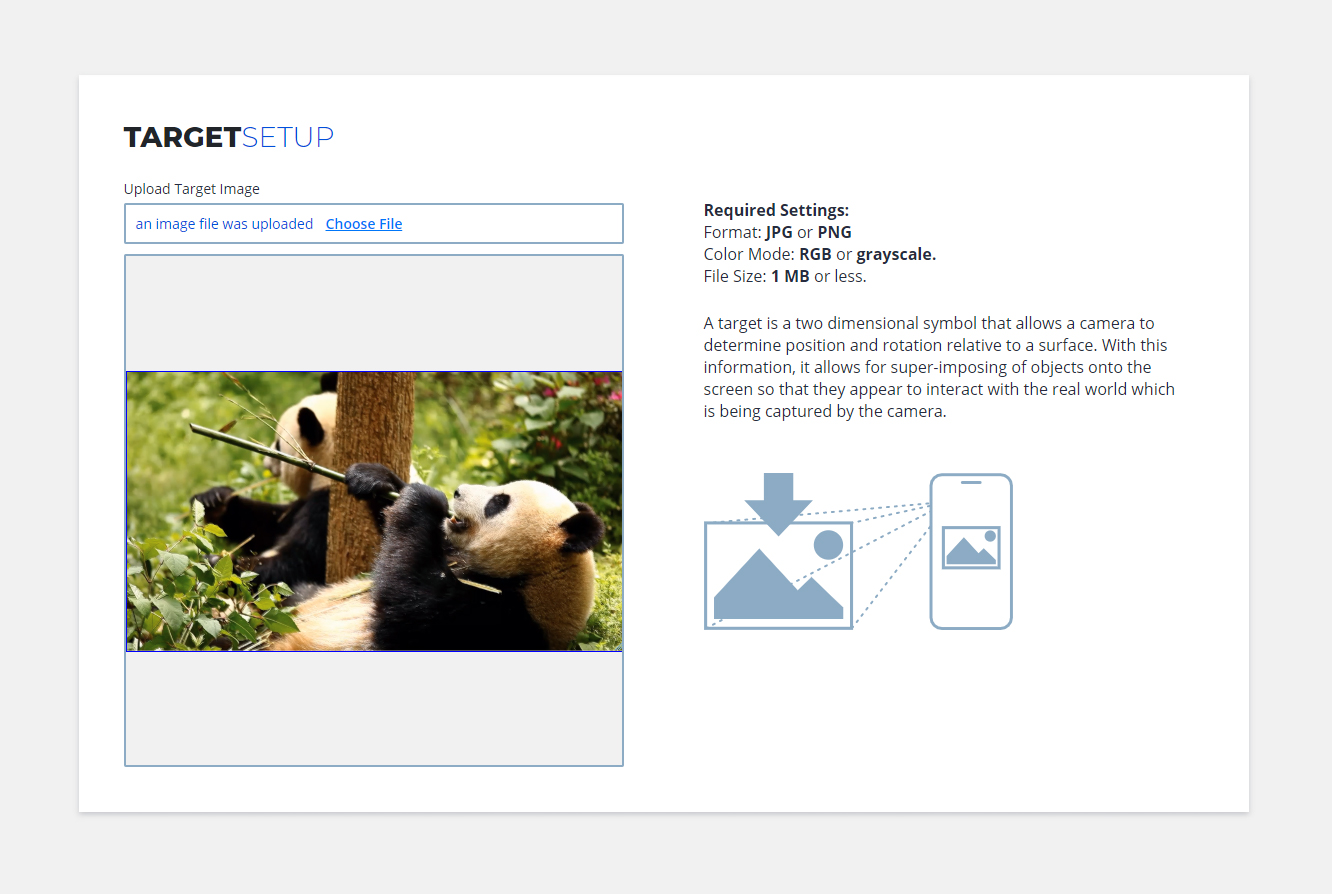
    With a simple drag and drop interface, you can upload the image you want to use. For example, it could be the cover of a magazine, a photo, drawing or painting in a textbook, or perhaps a travel brochure.


    Step 2


    • Upload a video or animation (optimal file size etc. Is explained on the screen)


    target setup 2

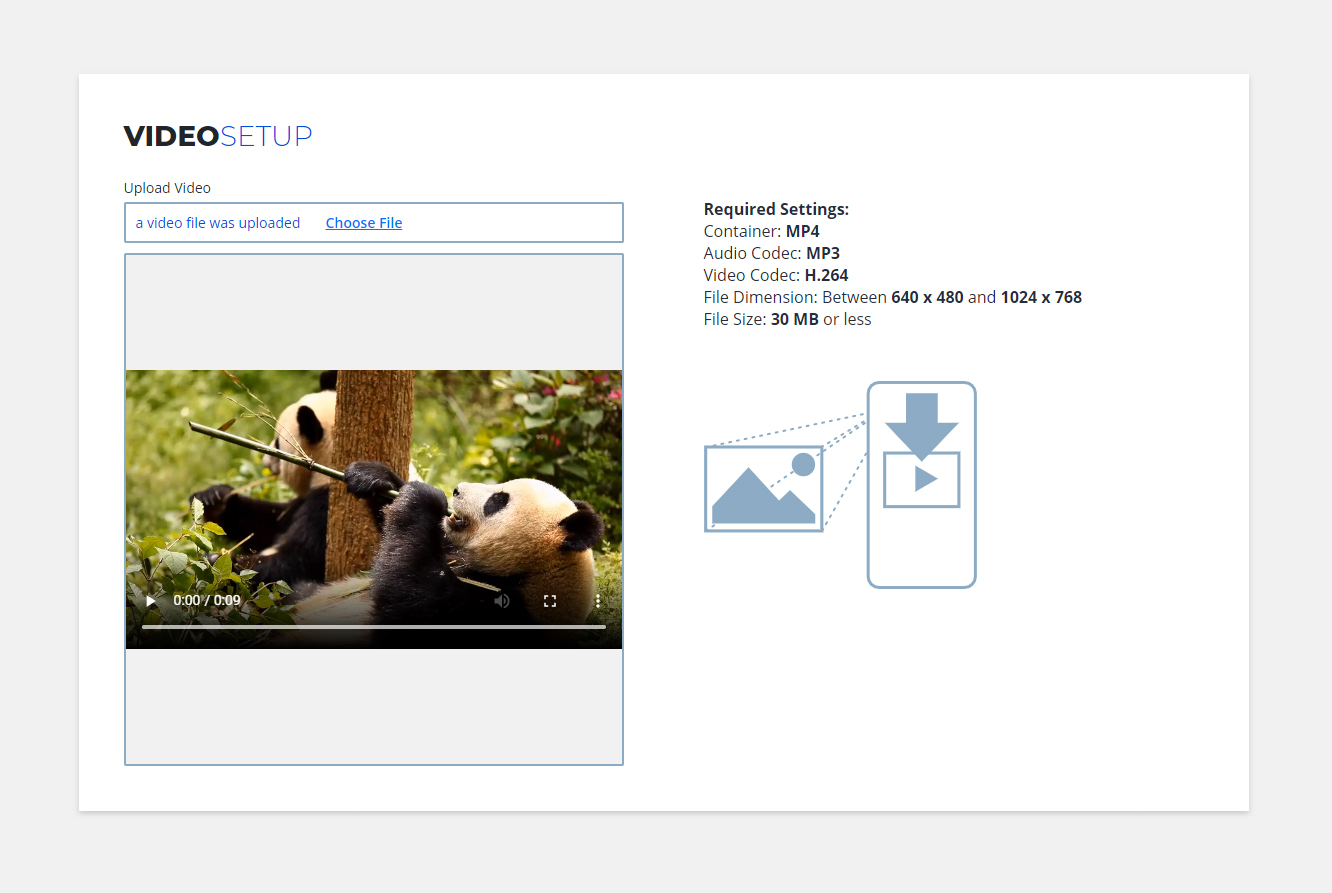
    Add a video with our simple drag and drop interface.


    Step 3


    This is a crucial step as measuring the success of your projects and initiatives is critical.

    • Drag and drop an image (optional)
    • Enter an HTML link for the image (optional)
    • Upload a button (optional) or let the image be the button


    target setup 3


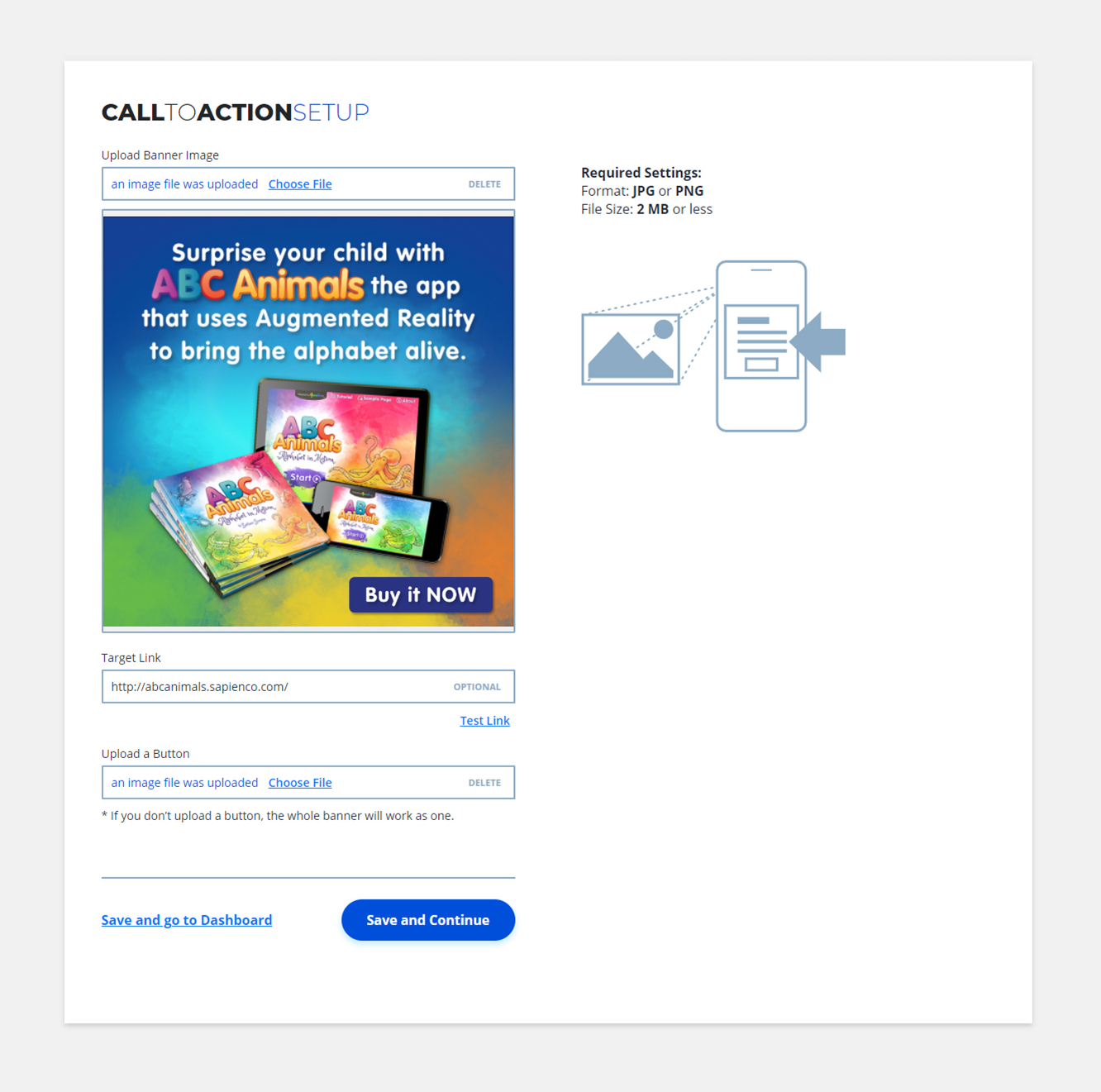
    Our imaged-based call to action allows us to present the user with additional information, product pages, polls, surveys, interactive content, deep-links, anything you can include in an image with a simple HTML link.


    After you complete the three easy steps, you tap or click on save and continue; this will take you to our confirmation page. Finally, if everything is OK, you can press publish.

    In our system, you can make changes at any time. And you can control expenses by limiting the number of recognitions and views you want to allow in a given period of time. As long as your project is live, you can make any changes you want. But be careful—your changes take effect in 30 seconds to five minutes. Your content is live; and no programming knowledge is required!


    Technologies we have seamlessly incorporated into our platform include:


    Other tools we believe are viable and well supported include:


    AR is affordable, immersive, and becoming a proven technology; it is essential to evaluate whether it  should be part of your business strategy.

    Work collaboratively (you can add your team to the platform at no additional cost), schedule content release ahead of time, make adjustments to your projects anytime.

    Release target-based, target-less, object tracking, scene tracking, self-facing, and real world-facing augmented reality experiences in minutes (not including creating creative content).


    In my next post, I plan to show you easy it is to publish browser-based augmented reality content in three easy steps at SparxWorks. Visit us at www.sparxworks.com to learn more about our AR business solutions. You can also come to see us in action this coming November 15 at www.ARExperience.us. This experiential conference will bring together the top brands and agencies with the hottest companies and services in AR in a collaborative way to foster the growth of our AR community.

    We look forward to seeing you there at the Faena Hotel in Miami beach.

  • 5 key tips to make sure your augmented reality initiative is a success

    5 key tips to make sure your augmented reality initiative is a success

    Let me start by saying that as a gamer at heart I love VR. However from a creative standpoint, real world application, and overall potential I am convinced that augmented reality (AR) provides a much bigger and interesting opportunity.

    Both AR and VR concepts have been around far longer than most people imagine. VR has been viewed for decades as the future, particularly for games, simulations, and at one point, to drive the creation of virtual worlds. For gaming and simulations VR can deliver a rich experience. But some of the old challenges still remain—limited social interaction, expensive to produce cool applications, risky ROI (the end user installed base is not as big as one would imagine and it is fragmented—accessed by multiple hardware systems).

    AR on the other hand is more social by nature because you don’t leave the real world. You can spend more screen time with it because you are not isolated. And in many cases you can use already existing devices to use the technology (2 billion mobile devices world wide). Don’t get me wrong. There are still many challenges to conquer, but there are also many more potential immediate applications for the technology.

    If you are interested in using AR for your business, products, promotions, etc. AR can definitely be a game changer for you. But there are some practical things you should keep in mind before you decide how to use this new technology.

    1. Like any media it all starts with a solid idea, objective—a clear vision of what you want to call attention to, or the point you want to make. Yes, writing is a big part of it, just like with movies, games, and any story.

    2. Consider that AR and mixed reality (MR) combine the real world with virtual elements. Planning, staging and particular attention to the user experience and user interface are super important. Simple is better.

    3. Think about it in three parts. First, setting. Next, context of the experience you are going to offer. And last, action or interaction you want the user to take during or towards the end of your AR experience.

    4. There are over 300 companies (and growing) dedicated to AR, but they are not all the same. Some companies provide core technologies and are essentially B2B businesses—oriented towards developers or publishers. Other companies specialize in vertical markets using other company’s technologies to deliver AR, and some companies are development teams, very similar to game or mobile applications development studios.

    5. Don’t forget, analytics are essential. The web, and mobile industry have shown the value and power of analytics. Analytics make it possible to improve user experience, fix defects, and add new features based on evidence and real-time feedback.


    There are of course other factors to consider, but you don’t have five hours to read now, right? To learn more about how North South Studios can help you use AR to extend your brand, you can contact me at 310-318-6156. Or join me and other AR experts at my upcoming panel at the Media Summit http://www.digitalhollywood.com/MediaSummit2017.html in New York this coming March 7 at 3.30PM

  • Projecting Video Streaming Cost in Your Business plan

    Projecting Video Streaming Cost in Your Business plan

    I have always enjoyed having video as one of the media components in my projects or presentations. Many years ago it was a challenge to get video to work from a disk with limited CPU cycles and video cards, not to mention extremely limited bandwidth. Yet, video always added so much to the project that it was well worth the extra work.

    As the years have gone by and disk as a delivery mechanism is a thing of the past, the internet has made it possible to provide a much richer experience. But, when you try to create a business plan, and you need to project revenue and expenses for 3 or more years, there are still many challenges.

    [blockquote width=’40’]

    Uplynk has the most straight forward pricing you will ever find—time based! You measure your encoding, storage and streaming based on time, which is great—a unit of measure we can all understand.

    [/blockquote]

    Most companies in the video streaming market offer a variety of packaged services, which work well for some businesses. However, the challenge is that most of the packages are measured in gigabytes, or transfer rates, etc. This makes it very hard to forecast cost and determine an accurate price point for your services or product. How do you predict gigabytes in a world where we deliver video to so many different devices—Macs, PCs, desktops, laptops, mobile devices, streaming boxes, video streaming boxes, game console, etc.

    Enter Uplynk, a new company with an exciting technology with a straightforward pricing plan. Uplynk features an adaptive stream, you encode one time (no equipment needed other than your current computer), you store economically just what you need—one version of your video—and stream to all devices. The video is HD by default and adaptable when the conditions require a lesser experience. And, for those of us who have to deal with the financial aspects of an operation, Uplynk has the most straight forward pricing you will ever find—time based! You measure your encoding, storage and streaming based on time, which is great—a unit of measure we can all understand. Even better, you only pay for what you use. No pre-set contract, Uplynk works with all ad services and includes DRM. There are plenty of other goodies but you can check them out at www.Uplynk.com. Uplynk was recently acquired by Verizon (good move, Verizon), which means they likely to even further expand their services in the days ahead.

    There are other good companies in the space that also provide great services, but I think Uplynk gets my vote for ease of use, easy to understand pricing, and great service. I worked with Ralf Jacob, their CEO years ago, and I was always impressed with his work ethic, dedication, and knowledge. Now, together with a great team, he has delivered a very special service to the market. If you are looking for a good streaming provider and great partner, check these guys out. You will not be disappointed. ESPN, Disney, and other giants in the industry seem to agree with me. Check out my blog tomorrow to learn about another great video technology.